
Fidèle Ezéchiel Koffi Hounnouvi
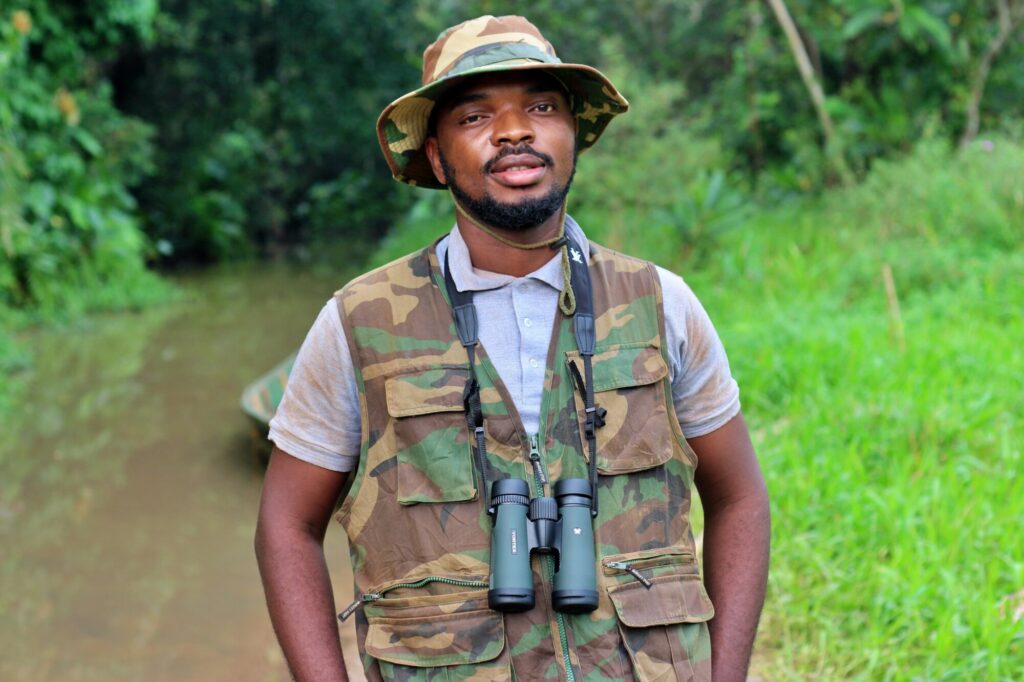
Fidèle Ezéchiel Koffi Hounnouvi, one of Conservation Nation’s 2026 Conservationist Grant recipients, is a Beninese conservation scientist and ecological and spatial data specialist based between Cotonou and Abomey-Calavi. He holds a master’s degree in management of Protected Areas and Biosphere Reserves, jointly delivered by ERAIFT (Kinshasa, DRC) and the Southern African Wildlife College (Hoedspruit, South Africa), and a professional bachelor’s degree in Agricultural Sciences.
He works at the intersection of three roles that reinforce each other. He runs field conservation projects for Beninese wildlife as Project Manager and Principal Investigator at NABEN NGO. He delivers spatial and ecological analyses to researchers, students, and organizations across the region as a freelance data scientist. And he coauthored two peer-reviewed papers on West African vulture conservation, published in 2025 in Ecology & Evolution and the Journal of Ethnobiology and Ethnomedicine.
His work focuses on West African primates, vultures, and swamp forest ecosystems. He currently leads a Rufford-funded conservation project on the primates of the Lokoli swamp forest, deploying camera traps, drone surveys, and community-based threat mapping. His bioacoustic project is the next step in that trajectory.
Project Overview
Lokoli is one of the last swamp forests of the Dahomey Gap, the narrow band of savanna and remnant forests running across southern Benin, Togo and Ghana. It shelters two Cercopithecus monkeys whose future is at stake: the Red-bellied Monkey (C. erythrogaster erythrogaster), the nominate subspecies found in Benin, listed as Critically Endangered, and the Mona Monkey (C. mona), listed as Near Threatened and retreating across much of West Africa.
Both species remain critically under-documented in Benin. Despite active hunting and continuous habitat loss, no acoustic baseline has ever been established for Lokoli. Yet their loud, species-specific calls make them ideal candidates for passive acoustic monitoring (PAM), a cost-effective, non-invasive method that has reshaped primate conservation elsewhere but that no team has yet deployed on primates in Benin.
This 12-month project will deliver that first baseline. Four AudioMoth recorders will be deployed across stratified microzones of the swamp forest during the dry season (November 2026 to March 2027), when acoustic propagation is at its best. Dawn-and-dusk sampling will target the peak vocalization windows of both species. In parallel, four young Beninese conservationists will be trained in the full acoustic workflow: recorder deployment, data retrieval, spectrogram analysis in Arbimon and Raven Lite, and template matching in R.
Field research will produce georeferenced presence maps by microzone, seasonal activity patterns, and the first open-access reference call library for both species, hosted on Xeno-Canto. Results will feed directly into the Village Surveillance Committees already active at the site, so that community patrols will finally know where to look.
